A complete guide for healthy modern lifestyle

Welcome! This site is specially designed to provide you latest information, tips and solutions to all your problems on health! Health and wellness are today's prime concern. We bring you the health & wellness guide which provides information on health and wellness topics. You are in the right spot! Want to search our site? Scroll down to the search box below.
Showing posts with label stroke. Show all posts

Sunday, January 2, 2011

Home Remedies for Heat Stroke

By on 6:29 AM
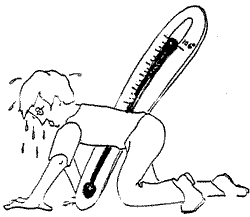
Heat stroke may also be referred to as: heat contractions, sunstroke, heat exhaustion and heat fatigue. This health state is often life-threatening. This situation occurs when people exert or play in scorching, sticky places and their body liquids are lost during sweating, causing dehydration the body to swelter. Heat sickness may be observed as an array of illness involving the body’s failure to deal with heat.

The average normal body temperature is 98.6 degree Fahrenheit. Heatstroke is an outcome of the inability of the body to regulate its own temperature, and body temperature continues to rise. Heat stroke is a non scientific name for hyperthermia, a body temperature that is so far beyond normal that physiological developments are subjected to harm and dysfunction. The negative outcome of hyperthermia can be temporary or lifelong and can cause unexpected death. The higher the temperature and the longer the hyperthermia continues the further harm it causes. It is a consequence of prolonged, excessive exposure to sun, in which an individual does not perspire enough to lower body temperature.

Every year, millions of people are exposed to the risk of severe heat. Outdoor laborers make up the major percentage of patients with heat connected complaints. Sportspersons, children and the aged also are often affected, with aged people being predominantly susceptible to heat stroke.
http://4.bp.blogspot.com/_Nb8DOoLyFwk/RoSyufFowpI/AAAAAAAACnU/_kHc7BH1zxc/s400/heatstroke.gif

Symptoms of Heat Stroke

Signs And Symptoms of Heat Stroke

Indications of heat stroke can at times impersonate those of heart attack or other conditions. Different people possibly will have different symptoms and indicators of heat stroke. However familiar symptoms and signs of heat stroke include the following:

1. Elevated body temperature

2. The lack of sweating, with burning red or flushed dehydrated skin

3. Trouble in breathing

4. Bizarre activities

5. Hallucinations and illusions

6. Nervousness and Anxiety

7. Convulsions

8. Loss of consciousness

Heat stroke can happen unexpectedly, without any symptoms of heat exhaustion. If someone is experiencing symptoms of heat stroke, it is important to seek medical attention at once.

Causes of Heat Stroke


High temperature is the main cause of heat stroke

Heat related conditions like heat stroke may arise when your body cannot remain cool. As the atmospheric temperature increases, your body stays cool as you sweat. On hot, sticky days, the loss of sweat is measured by the increased humidity in the air. Dehydration too is a major worry, as too much fluid loss can lead to heart and brain damage.
Chronic medical conditions like diabetes, nausea; vomiting or diarrhea can put children and adults at threat for a heat stroke in dreadfully hot climates. The other common causes of heat strokes could be as follows:

1. High temperatures or humidity

2. Extended and excessive exercise

3. Excess clothing

4. Too much use of alcohol

5. Cardiovascular ailments

6. Sweat gland dysfunction

7. Medications that weaken the body’s ability to sweat may have an effect on people to this problem

8. Pregnancy

9. Obesity


Remedies for Heat Stroke

http://graphics8.nytimes.com/images/2007/08/01/health/adam/17211.jpg

Victims of heat stroke should be moved to a cool area and clothing should be removed.

Heat stroke is a medical crisis involving hospitalization, and the local emergency system must be turned on as soon as possible.

1. The body temperature ought to be lowered instantly.

2. The sufferer should be moved to a cool area and clothing should be removed to encourage inactive cooling. Energetic cooling methods can be used.

3. The victim should be positioned into the revival pose to make sure that their airway remains open.

4. Cool the person by sponging with damp towel.

5. Water containing electrolyte, juices and glucose should be given to the victim.


Diet for Heat Stroke


Stay hydrated and minimize sun exposure.

Drink plenty of water, stay away from the sun, and avoid taxing activity during hot weather conditions. If you start experiencing the warning signs, shift to a cool, sheltered area and gulp something cool.


Suggestions for Heat Stroke

Try chamomile flowers to get relief from heatstroke

If you start experiencing the warning signs, move to a sheltered area and drink something cool. A few people also use chamomile flowers to alleviate the symptoms of heatstroke, though the effectiveness of this therapy is not assured.

After a complete recovery from heatstroke, a slight follow-up care is considered necessary. Improving patients may possibly desire to relax and reside in cool areas for some days. Patients should also implement aggressive prevention policies to keep heat stroke from returning.

Saturday, January 1, 2011

Home Remedies for High Blood Cholesterol

By on 6:11 AM

Cholesterol, a yellowish fatty substance, is one of the essential ingredients of the body. Although it is essential to life, it has a bad reputation, being a major villain in heart disease. Every person with high blood cholesterol is regarded as a potential candidate for heart attack or a stroke. Most of the cholesterol found in the body is produced in the liver. However, about twenty to thirty per cent generally comes from the food we eat. Cholesterol is measured in milligrams per 100 millimetres of blood. The normal level of cholesterol varies between 150 - 200 mg per 100 ml. In blood, cholesterol occurs in combination with certain lipids (fats), hence, known as lipoptroteins. There are two main types of lipoproteins: a low density one (LDL) and a high density one (HDL). The low density lipoprotein is the one which is considered harmful and is associated with cholesterol deposits in blood vessels. The higher the ratio of LDL to the total cholesterol, the greater will be the risk of arterial damage and heart disease. HDL, on the other hand, plays a salutory role by helping remove cholesterol from circulation and thereby reducing the risk of heart disease.


http://graphics8.nytimes.com/images/2007/08/01/health/adam/9377.jpg

High Blood Cholesterol Causes


Hereditary

Hypercholesterolaemia or increase in cholesterol is mainly a hereditary disorder.

Excessive consumption of rich foods

It is also caused by taking rich foods and fried foods: excessive consumption of milk and its products like clarified butter, butter, and cream; white flour, sugar, cakes, pastries, biscuits, cheese, and ice cream; and non-vegetarian foods like meat, fish, and eggs.

Smoking, Drinking and Stress

Other causes of increase in cholesterol are irregularity in habits, smoking and drinking alcohol. Stress has also been found to be a major cause of increased level of cholesterol.


High Blood Cholesterol Home Remedies


High Blood Cholesterol treatment using Lecithin

Lecithin, also a fatty food substance and the most abundant of the phospholipids, is beneficial in case of increase in cholesterol level. It has the ability to break up cholesterol into small particles which can be easily handled by the system. With sufficient intake of lecithin, cholesterol cannot build up against the walls of the arteries and veins. Lecithin also increases the production of bile acids made from cholesterol, thereby reducing its amount in the blood, Egg yolk, vegetable oils, wholegrain cereals, soyabeans, and unpasturised milk are rich sources of lecithin. The cells of the body are also capable of synthesizing it as needed, if several of the B vitamins are present.

High Blood Cholesterol treatment using Vitamins

Vitamins B6, choline, and inositol are particularly effective in reducing the level of blood cholesterol. Wheat germ, yeast, or vitamin B extracted from bran contain high quantities of these vitamins. Vitamin E also elevates blood lecithin and reduces cholesterol. The patient should take liberal quantities of vitamin E-rich foods such as sunflower seeds, safflower, soyabean oils, butter, and sprouted seed and grains.

High Blood Cholesterol treatment using Sunflower Seeds

Sunflower seeds are valuable in lowering high blood cholesterol. They contain a substantial quantity of linoleic acid which is the fat helpful in reducing cholesterol deposits on the walls of arteries. Substituting sunflower seeds for some of the solid fats like butter and cream will, therefore, lead to great improvement in health.

High Blood Cholesterol treatment using Coriander Seeds

Regular drinking of a decoction of coriander seeds helps lower blood cholesterol. It is a good diuretic and helps stimulate the kidneys. It is prepared by boiling two tablespoons of dry seeds in a glass of water and straining the decoction after cooling. This decoction should be taken twice daily.

High Blood Cholesterol treatment using Ishabgul

The herb psyllium husk has been found beneficial in the treatment of high cholesterol level. The oil of the seeds of this plant should be given for lowering blood cholesterol. It contains fifty per cent linoleic acid. This oil is more active than safflower oil, and one teaspoon should be taken twice daily.

High Blood Cholesterol treatment using Fibre

The amount of fibre in the diet also influences the cholesterol levels and LDL cholesterol can be lowered by taking diets rich in fibres. The most significant sources of dietary fibre are unprocessed wheat bran, whole cereals such as wheat, rice, barley, rye; legumes such as potatoes, carrots, beet, and turnips, fruits such as mangoes and guavas; and leafy vegetables such as cabbage, lady’s fingers, lettuce and celery. Oat bran and corn bran are specially beneficial in lowering LDL cholesterol.


High Blood Cholesterol Diet


Avoid Rich Foods

To reduce the risk of heart disease, it is essential to lower the level of LDL and increase the level of HDL. This can be achieved by a change in diet and lifestyle. As a first step, foods rich in cholesterol and saturated fats, which lead to an increase in the LDL level, should be reduced to the minimum. These foods are eggs, organic meats, cheese, butter, bacon, beef, and whole milk.

Avoid food with animal origin; Avoid palm and coconut oil

Virtually all foods of animal origin, as well as two vegetable oils, namely, coconut and palm, are high in saturated fats, and these should be replaced by polyunsaturated fats such as corn, safflower, and soyabean, and sesame oils which tend to lower the level of LDL.

Drink at least 10 glasses of water each day

Persons with high blood cholesterol level should drink at least eight to ten glasses of water every day, as copious drinking of water stimulates the excretory activity of the skin and kidneys. This, in turn, facilitates elimination of excessive cholesterol from the system.


Other High Blood Cholesterol remedies

Regular Physical Exercise

Regular physical exercise also plays an important role in lowering LDL cholesterol and in raising the level of protective HDL. It also promotes circulation and helps maintain the blood flow to every part of the body. Jogging or brisk walking, swimming, bicycling, and playing badminton are excellent forms of exercise.

Wednesday, December 22, 2010

Home Remedies for Sleep Apnea

By on 2:09 AM


The term “apnea” means without breath and sleep apnea is a disorder characterized by stopping or pausing breath during sleep. This is not a mild sleep disorder as longer pauses between breaths can lead to fatal consequences. Each pause in breathing spans between ten to twenty seconds or more but these pauses occur more than twenty to thirty times every hour.

Sleep apnea occurs because adequate air is unable to flow in to the lungs through the mouth or nose as one tries to breathe regularly causing a pause in the breathing activity. Normal breathing resumes with a sudden snort or choking sound but the oxygen levels in blood drop every time there is a pause in breathing.

Sleep apnea is broadly classified into two types: Central and Obstructive. Central sleep apnea is caused due to lack of effort in breathing regularly while Obstructive Sleep Apnea is caused due to a physical block in regular breathing despite effort.

If left untreated sleep apnea can cause: hypertension, stroke, irregular heart beat, heart failure or heart attack.

Symptoms of Sleep Apnea

The most common signs associated with sleep apnea

- Loud snoring
- Dry or parched throat on waking up
- Gasping or choking for breath
- Poor quality of sleep leading to sleepiness during the day
- Memory problems
- Morning headaches
- Relatively higher levels of irritation
- Inability to concentrate for a longer duration
- Depression or mood swings


Causes of Sleep Apnea

key causes of Sleep Apnea

The causes and concerns that lead to sleep apnea as a disorder are:

- Inability of the air to flow to the lungs from the mouth or nose due to physical obstruction or lack of effort
- Brief collapsing of the throat causing pauses in breath
- The extra soft tissues in the throat among obese or over weight persons make it difficult to keep the throat area open for circulation of air
- Large tonsils or adenoids may also cause disruption in air flow to the lungs causing pauses in breath
- Hereditary or genetic features of the body such that the shape of the head and neck result in a relatively small airway between the mouth and throat area


Remedies for Sleep Apnea

Common remedies suggested by medical practitioners

- Quit smoking and lose weight if a person is overweight
- Avoid alcohol and consumption of sleeping pills
- Change sleep positions to ensure regular breathing
- Tie a ball in socks and tie it across your waist such that you will change your position regularly
- Avoid sleeping on the back and try sleeping laterally
- Conduct polysomnography, a diagnostic test which measures and records a number of physiologic variables during sleep.


Diet foe Sleep Apnea

Any Diet for Sleep Apnea?

There is no specific diet or particular foods that can help treat or prevent sleep apnea

Home Remedies